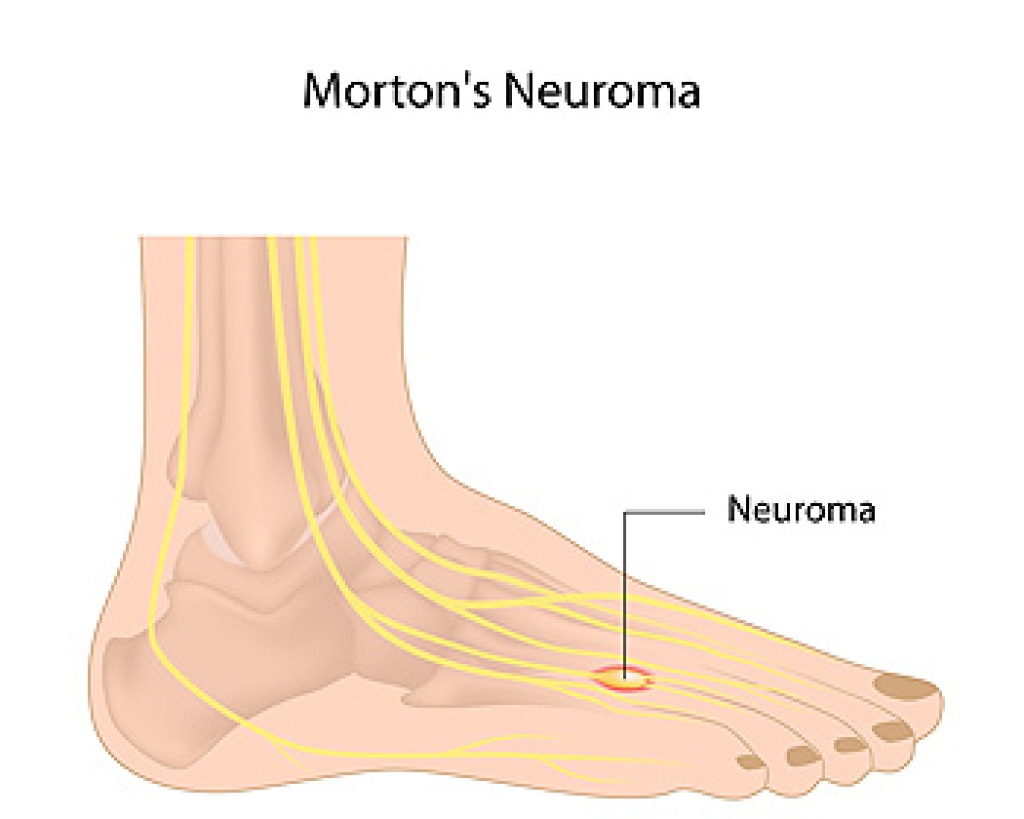
Morton’s neuroma affects the ball of the foot, most commonly between the third and fourth toes. It is sometimes referred to as Morton’s disease, although it is not actually a disease but a nerve irritation or thickening of the tissue surrounding a nerve. This condition develops when the nerve leading to the toes becomes compressed or irritated, often causing sharp or burning pain. Many patients describe the sensation as walking on a small pebble or having a fold in their sock that will not go away.
The causes of Morton’s neuroma are closely related to repetitive pressure and irritation of the forefoot. Wearing tight or narrow shoes is one of the most common factors, especially footwear with a narrow toe box or high heels. These shoes place extra pressure on the front of the foot and squeeze the toes together. High-impact activities like running or sports that involve repeated forefoot stress can also increase the risk. In some cases, foot structure plays a role. This includes flat feet, high arches, or abnormal toe alignment, all of which can increase nerve compression.
Risk factors for Morton’s neuroma include prolonged use of improper footwear, participation in high-impact sports, and occupations that require long periods of standing or walking. Women are more commonly affected due to footwear choices, but the condition can occur in anyone. Symptoms often begin gradually with mild tingling or numbness in the toes. The pain may become more intense, especially when wearing shoes or applying pressure to the forefoot. Some people may also experience burning sensations or a feeling of instability when walking.
Diagnosis and treatment of Morton’s neuroma typically involve a thorough evaluation by a podiatrist. A physical examination, along with imaging if needed, helps confirm the condition and rule out other causes of foot pain. Treatment options may include footwear changes, custom orthotics, padding to reduce pressure, and anti-inflammatory measures. In more persistent cases, injections or minimally invasive procedures may be recommended to reduce nerve irritation. Surgery is considered when conservative treatments do not provide relief. If you have signs of Morton’s neuroma, it is strongly suggested that you consult a podiatrist for a proper diagnosis and treatment.
Morton’s neuroma is a very uncomfortable condition to live with. If you think you have Morton’s neuroma, contact Derek Smith, DPM of Oklahoma. Our doctor will attend to all of your foot care needs and answer any of your related questions.
Morton’s Neuroma
Morton's neuroma is a painful foot condition that commonly affects the areas between the second and third or third and fourth toe, although other areas of the foot are also susceptible. Morton’s neuroma is caused by an inflamed nerve in the foot that is being squeezed and aggravated by surrounding bones.
What Increases the Chances of Having Morton’s Neuroma?
- Ill-fitting high heels or shoes that add pressure to the toe or foot
- Jogging, running or any sport that involves constant impact to the foot
- Flat feet, bunions, and any other foot deformities
Morton’s neuroma is a very treatable condition. Orthotics and shoe inserts can often be used to alleviate the pain on the forefront of the feet. In more severe cases, corticosteroids can also be prescribed. In order to figure out the best treatment for your neuroma, it’s recommended to seek the care of a podiatrist who can diagnose your condition and provide different treatment options.
If you have any questions, please feel free to contact our offices located in Ponca City, and Stillwater, OK . We offer the newest diagnostic and treatment technologies for all your foot care needs.
